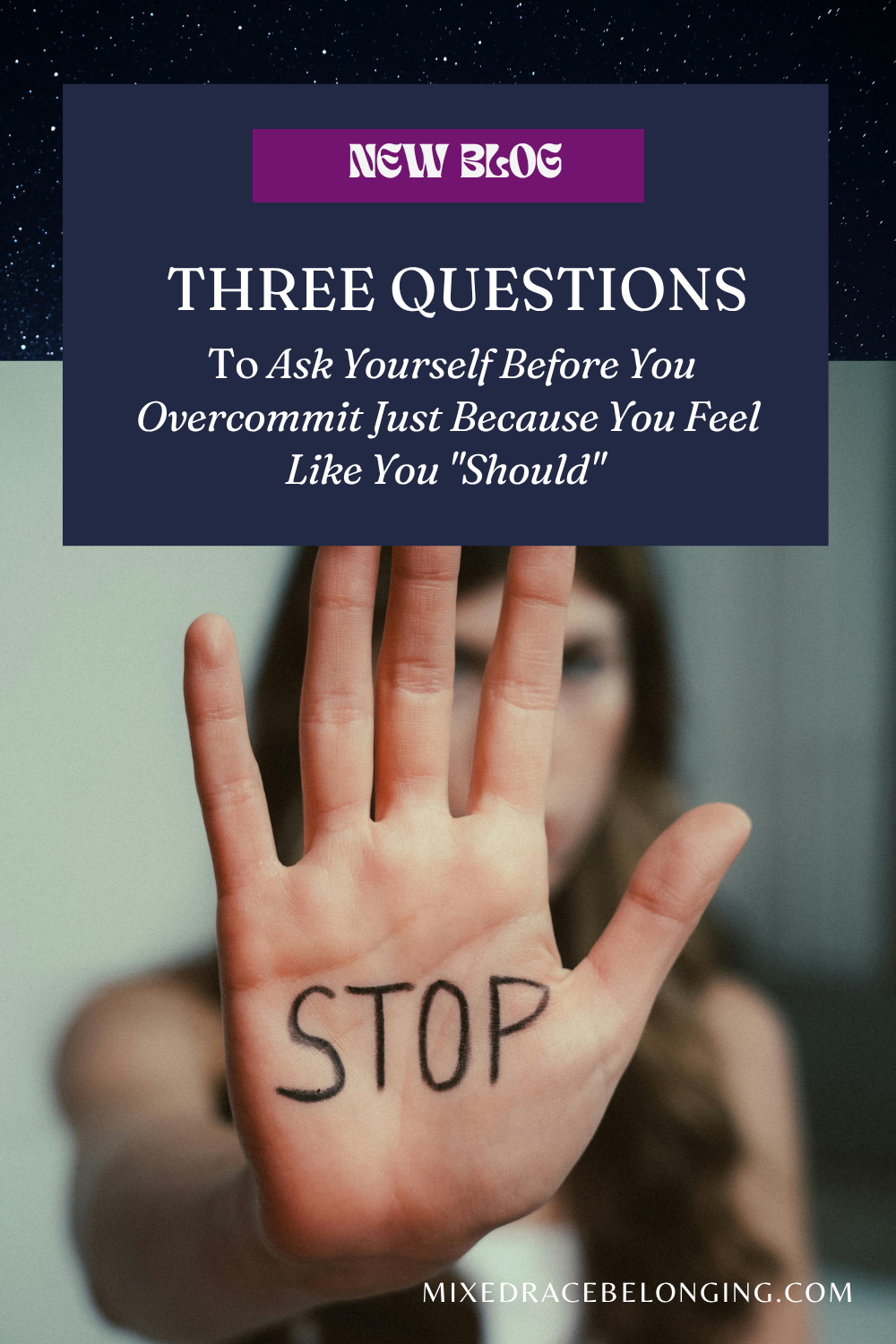
Three Questions to Ask Yourself Before You Overcommit Just Because You Feel Like You "Should"
Want to listen to this in podcast form? Click here.

If you tend to say yes to every request you get from your family and friends, only to feel overstretched and full of regret when the time comes to follow through, you probably aren’t slowing down enough to actually check in with yourself and make an informed decision.
In this blog, I’m going to walk you through a framework I designed to help a real-life client be more intentional with their commitments.
Don’t Should on Yourself
Before I dive in, I want to name a common experience I see in clients who have trouble saying no and setting boundaries. That’s the tendency to “should” on oneself. Underneath the impulse to say yes tends to be a very loud part of you who has internalized what it means to be a good, reliable, caring friend or partner or sibling.
This part of you is hyper focused on these expectations you’ve internalized, generalizing them across all situations. Look, it’s great to have values around being a good person, but you still need to practice discernment when it comes to committing.
The Three-Step Framework That Will Help You Stop Overcommitting
Here’s a three step framework that can help you discern shoulds from what’s really true for you. The acronym spells out an abbreviated term for ‘definitely,’ DEF – meaning that if you can answer every question with a full-body YES, then you can DEF commit to what’s being asked of you.
Desire
First, do you actually have a real desire to say yes. Not, do you feel like you should, but do you actually want to? You need to figure this part out first.
It’s possible that you feel split – maybe a part of you wants to, or values the request someone is making, while other parts are worried about what will happen if you overcommit. Or maybe there’s an opportunity that feels somewhat interesting and satisfying, but doesn’t fully meet YOUR needs.
As an example, one of my best friends and I enjoy song circles – she actually introduced me to them – and so I asked her to let me know when there were more coming up. Now, I’ve been able to go to some really great multiracial song circles, but one day she invited me to one and gave me fair warning that I’d likely be the only person of color there. Part of me longed to attend, and sing, and enjoy all that good energy. But another part of me knew that a primarily white space wasn’t going to feel as safe or comfortable as I’d like. So I ended up saying no, even though other than this one factor, the event sounded desirable.
Energy
Secondly, do you actually have the energy? Or does saying yes mean you are pushing yourself past your capacity?
I’m blessed to have parents that frequently come to visit me and help me with projects around my house, and I want them to feel equally supported by me. Recently, my dad had surgery. I kept telling my parents that I was coming home to help out around the house, and generally keep them company while my dad recovers, but as the date drew nearer I noticed I was feeling exhausted and overwhelmed by my own to-do list. I’d been sick myself in August, and house chores like mowing the lawn, vacuuming, giving the dog a bath had all fallen to the wayside. My mom and dad - thankfully - noticed my energy and my dad said in the most genuine, non-chalant way, “Don’t come on account of me! I’m fine!”
I know I’m lucky to have parents – and other relationships – who give me this explicit permission, and I know that there may be relationships you have where it’s not given as freely. This is important information for you. Healthy relationships mean that your loved ones know they can make requests of you – but they also have to respect your limitations, rather than piling on the guilt and manipulation tactics when you say no.
The reality is, surviving late-stage capitalism means we are all often stretched beyond our means, and while we may need to stretch to maintain our relationships, we also have to have relationships that recognize we are all doing the best we can!
Finances (and other resources)
Finally, do you actually have the tangible resources to meet this request? This could include finances, but it could include other resources like housing, transportation, and so on.
When I was refining this framework, I talked with a friend of mine to see if I was missing anything. We ended up having a conversation about the financial aspect of this framework. My friend is a classic eldest daughter of immigrants, and is often asked by her family members to help them with health care and other costs. My friend is both an extremely stable and generous human, and has done a lot of her own therapy to discern more clearly when she feels like she “should” send money, from when she actually feels resourced and values aligned to do so.
How Somatic Coaching Can Help
This framework is part of the Doubtless Decisions pillar in Bold Belonging, my four-month somatic coaching experience that helps you build an intentional support circle of at least 3 chosen family in 16 weeks - even if you’re afraid you’re “not enough” or “too much.”
Inside Bold Belonging, we’ll work through this framework as many times as we need to, while really learning how to listen to your body and the subtle messages that are communicated through emotion, sensation, images, and urges. We’ll also tend to the underlying inner conflicts between the parts of you who clearly know what you want to do and the parts of you who are feeling weighed down by the “shoulds.” We do all this so you can:
Approach every conversation and recover from every conflict with energy that says ‘I got this’.
Assess your needs and make relationship decisions without asking everyone around you for validation.
Communicate limits clearly without overexplaining, disappearing, or cutting people off unnecessarily.
and Ask for support, receive care, and build relationships where your needs are allowed to matter too.
My client Katy is a great example of how this work can help. Before working with me, Katy (Irish & Filipina) was already practicing setting boundaries...but then she would often waffle on them because she was afraid she was asking for too much.
I taught Katy somatic and cognitive frameworks like this DEF framework that helped her assess her needs and make decisions more quickly, without questioning herself. Katy says this “cracked open a new way to think about” her relationships. She realized that she had been abandoning her own intuition and needs because she felt like she “should” accept her partner for who he was in a sort of mindful acceptance way, despite feeling deeply unsatisfied in the relationship. As a result of our work, she gained the courage to walk away from a relationship where she had been feeling unsatisfied for a long time.
So, just a fair warning, working together might mean you end up leaving your deadbeat boyfriend!! If you’ve been dying to do this, or get more comfortable just expressing your boundaries and limitations with loved ones, let’s work together.
I’m currently taking new clients for Bold Belonging, and have space for about two new clients this fall.
So if you understand boundaries in theory but struggle to hold them when someone is disappointed – if you want to be a supporting, loving person to your loved ones without burning out – let’s talk.