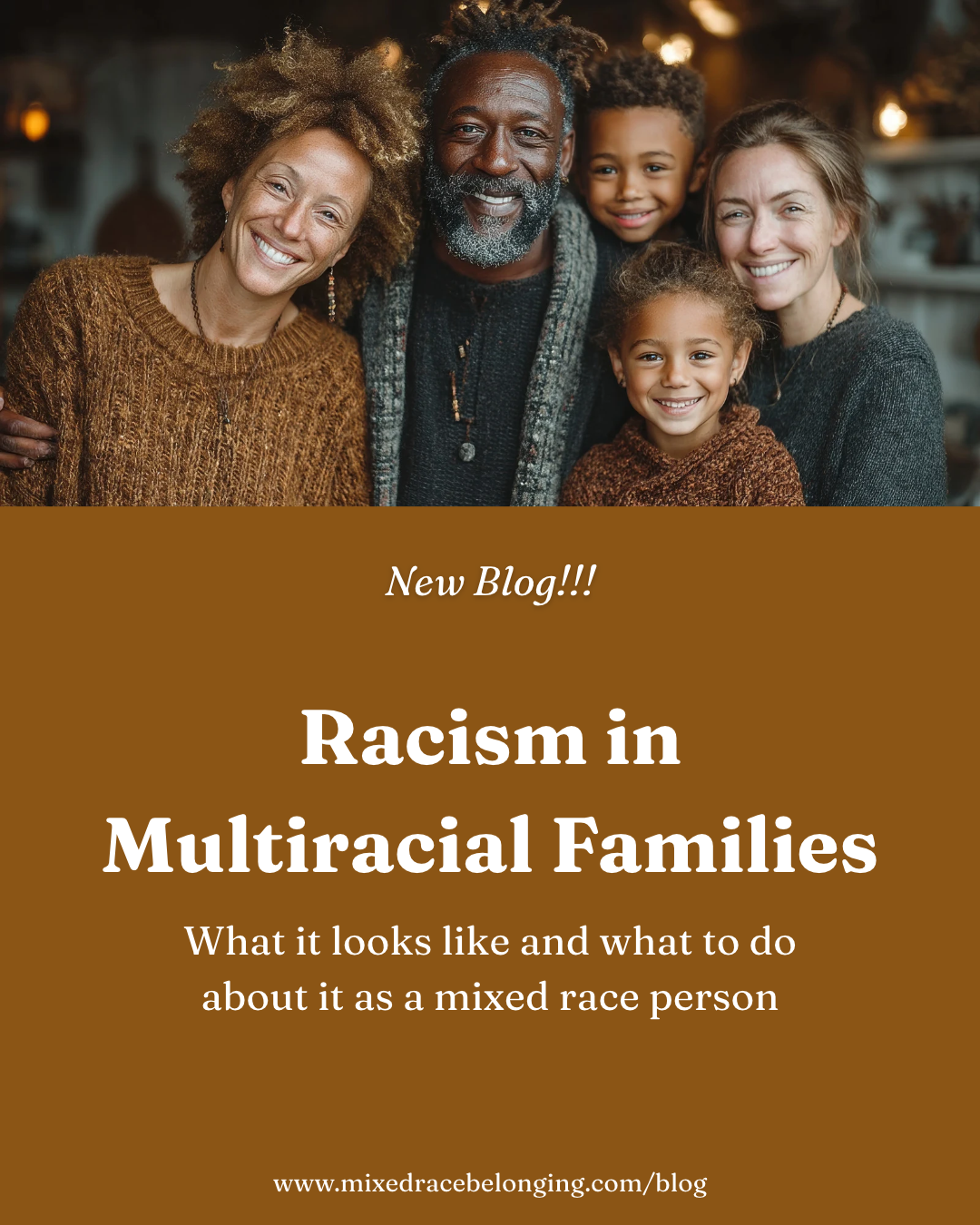
Being mixed, biracial, or multiracial can mean, not only are you consistently flooded with ‘what are you?’s and ‘but you’re not really…’s from random people on the street – you can also be microaggressed (and macroaggressed) within your own family.
In this blog, I’m going to share more about what this intra-family racism can sound like, the impact it tends to have on mixed race people, and how you can heal from these experiences and still live a fulfilling life.
Racism in Multiracial Families
Multiple research studies on mixed race people report a fairly common experience of racism and microaggressions within multiracial families.
That may include racism that may be familiar to all racialized people – whether monoracial or multiracial – such as:
Playing at stereotypes: Like the use of slurs and casual racist "jokes.”
Othering: Making jokes about the way you pronounce certain words.
Alignment with racist politics: And even behaviors that communicate ignorance or outright prejudice toward part of your heritage, like white family members who have confederate flags.
Colorblind ideologies: When family members use phrases like “I don’t see color”
It’s also common for mixed race people to experience monoracism – the kind of racism specifically related to being mixed, such as:
Denial of identity or questioning authenticity: Relatives may say “you’re not really Black because you grew up in the suburbs,” or “you’re not really Filipina because you don’t speak Tagalog,” or they may judge your appearance, accent, or the partner you choose as being inauthentic.
Denial of reality: This happens when relatives question whether your experiences are accurate (like being teased at school) or dismiss your feelings, telling you you’re being “sensitive” or acting “entitled”
Isolation and favoritism: Like when you are given unequal treatment (whether positive or negative) based on different phenotypes, skin tones, or hair texture, for instance.
How Intrafamily Microaggressions Impact Multiracial People
These experiences are so painful, because families are – for all intents and purposes – supposed to offer “built-in” belonging and a sense of refuge from the outside world. But at the end of the day, these kinds of comments and treatments leave you feeling isolated, like an alien amongst your own people.
Worse yet – even if you have other siblings who are mixed, that doesn’t mean they see or experience the world in the same way you do. This means that you don’t have an “ally” so to speak within your own family. They may side with other family members, or benefit due to having a different phenotype than you or different political beliefs.
These experiences mean you are experiencing a kind of erasure of your experience – whether explicitly being dismissed and minimized, or through something more subtle, called mirroring. Mirroring is when a parent or caregiver reflects back a child’s emotions, facial expressions, thoughts, or behaviors so that the child feels validated and understood.
Importantly – even the best parents can be empathetic, yet unable to effectively support mixed race children due to lack of experience and education. Which means even if you didn’t experience explicit racism or microaggressions in your family, you still might feel misunderstood or unseen by your family.
And because all of these experiences can happen so early in life – and occur so persistently – they often result in a kind of emotional trauma that can make it hard to:
Develop a strong sense of self (both with regards to racial identity, and in general), leading to a deep sense of emptiness
Learn how to regulate emotions that arise when you are othered or microaggressed at school or social spaces, leading to impulsive patterns of anxiety or avoidance
The Mixed Race Belonging Wound
And all this makes it extremely hard to build healthy relationships. You might accept poor treatment in your relationships, feel responsible for other people’s emotions, or adjust yourself to fit everyone else’s expectations. You might also internalize every experience where you don’t vibe with someone else as rejection, which makes it hard to feel resilient and persistently seek connections that feel validating.
This all results in what I call the Mixed Race Belonging Wound.
The Mixed Race Belonging Wound is a relational wound. This means it doesn’t just result in anxiety or depression that you experience in a vacuum – as I said before, it shapes your capacity to develop and maintain healthy relationships.
The problem is relationships are actually an extremely critical metric of wellbeing. A few years ago, the U.S. Surgeon General released a report detailing what we now understand as ‘The Loneliness Epidemic.’ The report explains that social disconnection is not just a bad feeling – it increases the risk of premature death, outpacing the health risks associated with other factors including smoking cigarettes.
And importantly – the only real cure for this epidemic is more – and better – connection.
Healing From Family-Based Racism
As a practicing trauma therapist for nearly a decade, I can tell you that research in neuroscience and attachment poses a similar solution: the only way to heal the wounds that have happened in relationships is through relationships that offer a corrective experience. This includes new relationships, as well as the possibility of repair within relationships where rupture has occurred.
Chosen Family
I think it’s important to remember that while you don’t get to pick your biological (or even your adoptive) family, as an adult you DO have agency over which relationships and which kind of people you choose to invest in. That’s why I think chosen family can be so incredibly healing for mixed race individuals.
Chosen family is a group of people that you intentionally decide to love, trust, and support. The concept has roots in the queer community, a brilliant solution to the rejection and isolation many queer individuals have historically experienced from biological relatives. Early examples include things like ballroom and drag “houses,” which offered shelter, safety, and support when people were turned away from their families of origin.
But anyone experiencing unmet connection needs or family estrangement can build a chosen family.
And regardless of how you decide to manage hard family dynamics, chosen family can be a gamechanger.
I can't promise you that your auntie will never make another snide comment about how you chose to marry a white dude.
I can't promise you that your cousin won't call you a “cryracial” again.
I can't promise that your other cousin will listen to you when you educate his dumb ass on why the confederate flag is problematic as hell.
But I can promise you this – when you have chosen family, figuring out what to do with these people (if you do anything at all) becomes so. much. easier.
Chosen family is a buffer against all this bullshit. They are a home base you can return to after a hard family gathering. They are the ones who will listen and validate and strategize with you – or say fuck it, let's not give them any of our time and energy, and go out dancing on a Tuesday night.
So that when the things I mentioned above happen it’s easier to let it roll off of you because you have people who you don’t need to overexplain yourself to.
Here’s the thing – every time you don’t have anyone to lean on it just isolates you further and confirms this narrative that you don’t belong anywhere, or worse – that you aren’t “enough” to belong anywhere.
But when you have chosen family, things are so much easier knowing you have a safe place to land where you don’t have to shrink, shapeshift, or push to be seen.
But What About Aunt Karen?
I also know that, even if you decide to focus on building out chosen family, that doesn’t mean your existing family issues go away!
One of the most COMMON questions I get is “how do I approach my friend/cousin/mom about [insert problematic thing they do]?”
And my answer is…it depends. It’s not as simple as, “give them the benefit of the doubt,” or “cut ties with all toxic family members,” or “just explain yourself.”
It depends on:
What the relationship means to you; a relationship with your mom might be of different than your relationship with your aunt or third cousin, for instance.
What you know about the other person; how well they have historically responded during conflict?
And how prepared you are to manage whatever happens; can you stay grounded in the moment? What communication strategies will you use? How will it affect you in the days following?
That’s why one of the specific tools I created to help my clients inside on-on-one coaching is the Relational Discernment Scale. This tool helps you discern whether someone is worth confronting at all, and if so, what you need to do in order to prepare for that conversation. With a tool like this, instead of banking on the best case scenario or freezing up when the moment comes, you can establish a clear direction for conversations with these family members.
Work With Me
Whether you choose to address racist comments head-on in your family or go full no contact – or something in between – I can help you inside Relationship Rescue, my private one-on-one coaching program where we’ll resolve one sticky problem in your relationships or social life in four weeks.
On coaching calls, we can talk through tools like the Relational Discernment Scale, as well as others that I’ve created, and collaboratively come up with a plan. That might include exactly what you’ll say to your cousin about how they’ve hurt your feelings, or it might include how to talk to a friend you want to establish a deeper relationship with or build into your Thanksgiving ‘aftercare’ plan, for instance.
Plus, one of my favorite parts of Relationship Rescue is Oh Shit Support, where you can voice or text me between sessions to put any finishing touches on your plan, for a pep talk to remind you that you got this, or for some words of affirmation if things go wrong.
If you’re already bracing for family time over the holidays, Relationship Rescue is the perfect next step. We’ve got just enough time to prepare you for what’s to come – I mean, how nice would it be to roll into 2027 without a family drama hangover, knowing that you handled things the very best that you could, or with a support circle of chosen family you can actually enjoy spending time with?
Book your free call today and let’s talk.