How To Actually Create Belonging as a Mixed Race Person Instead of Feeling Like a Failure for Not Having It
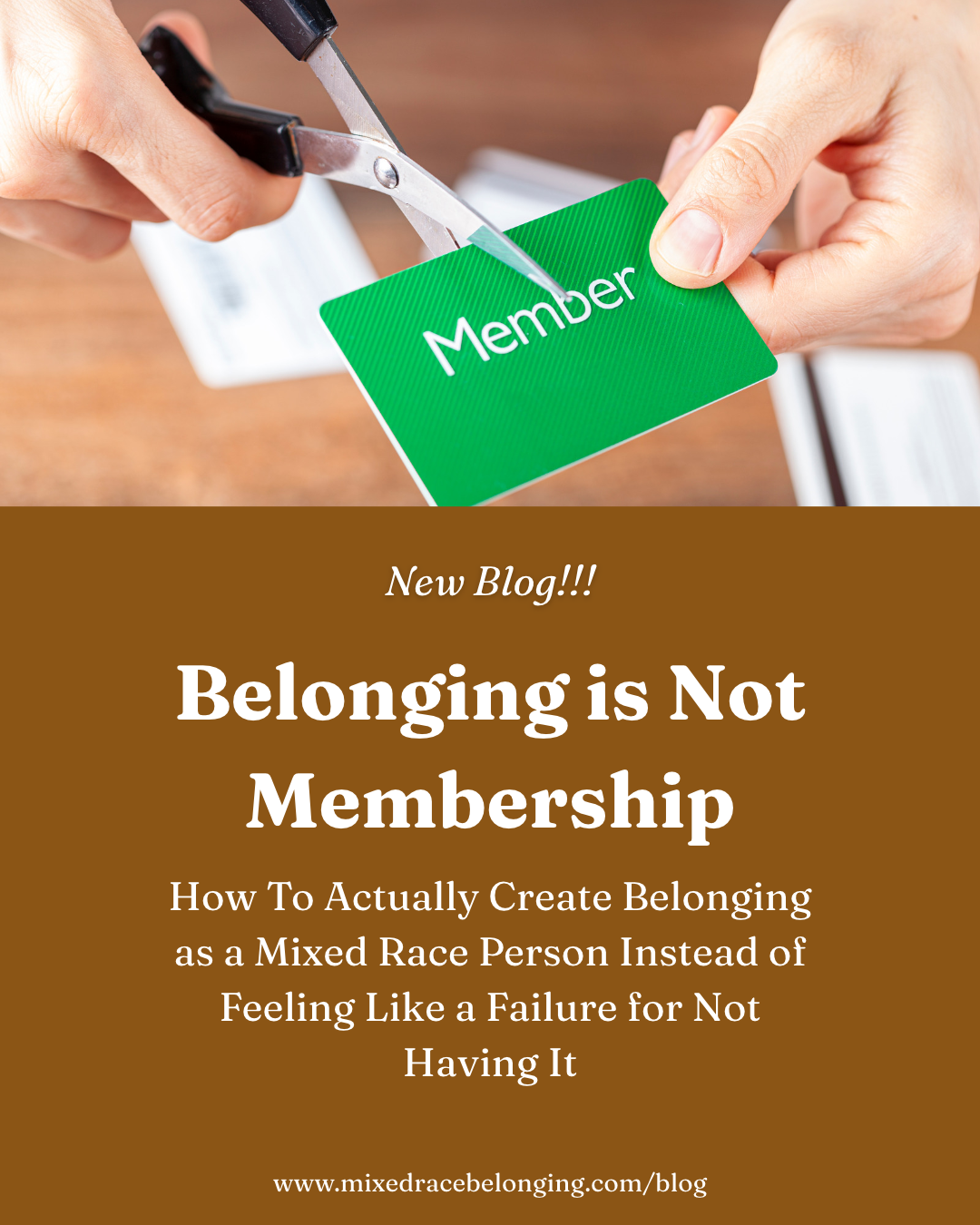
The question of “where do I belong?” is an understandable one. The only problem is – it can also be a distraction from actually finding belonging when the underlying assumption is that belonging is purely group membership or assumed sameness.
A family who does everything together or a singular monoracial friend group are all idealized versions of belonging. They exist, and they are wonderful, but there’s a lot more to belonging than just a collection of people who share identity.
If you lack racial identity-based belonging, it can feed into the narrative that you don’t belong anywhere, or that you’re not enough to claim belonging to some aspect of your identity.
In this blog, I’m going to expand on this trap and share a better way to think about belonging.
Racial Identity Isn’t Enough to Find Belonging
I hear from people all the time this sentiment that ‘if I just knew how to identify, then I’d find belonging.’ But you can be in a room full of people who share your racial identity and still not feel like you belong, for many reasons. Here’s a couple:
Monoracism From Your Own People
The first is the reality that not everyone you share a racial identity with will understand the nuances of your mixed identity or your unique experience. Comments from monoracial people like, “you’re only half,” or, “that’s your white side,” illustrate how othering can happen from the people you automatically consider “your people.”
This means that even if you land on the perfect words to describe your identity, even if you proudly claim your heritage, and still be othered and rejected from the people you are seeking belonging with.
These are really microaggressions that fall under the umbrella of monoracism, which is the kind of racism that specifically discriminates against people who don’t fit into discrete racial categories. Importantly, this rejection doesn’t negate your identity. It just means you’re talking to someone who has a monoracist understanding of racial identity.
No Racial Group is a Monolith
It also might be because your life experiences are too different – that your own personal flavor of your racial identity is different from theirs.
I was recently watching a clip of Barack Obama talking with two basketball players about being biracial. In the clip Barack mentions a moment in college where he was teasing a monoracial Black friend who he describes as a “Carlton Banks” type. Presumably, he was mocking this person’s expression of Blackness. Barack says that another Black student generously called him in and reminded him, “hey, your Blackness is also different, don’t do that to him.”
The sense of being different or “not enough” is a reality even some monoracially-identified people face from other people with the same racial identity. But no racial group is a monolith. There may be trends that shape a sense of shared identity or culture, but they never wholly capture the diversity within the group.
Roots, Rights, and Responsibilities of Identity-Based Belonging
There are plenty of monoracial people out there who have no problem whatsoever with welcoming mixed race kin. But even when that happens – your identity alone will never be enough to justify your membership.
This summer, I interviewed my mentor and mixed auntie elder, TaRessa Stovall, on the Roots, Rights, and Responsibilities of being Black mixed race. TaRessa is someone who grew up steeped in Black culture, with a Black father and a Jewish mother. In our interview, TaRessa talks about the idea of cultural humility, and engaging in new cultural spaces with humility and reverence. She shares, for instance, how much of a newbie or guest she would feel in Jewish spaces. Despite being Jewish and the right to claim that aspect of her ancestry, she strongly feels we have a responsibility to really intentionally learn how to engage with cultures that we weren’t brought up in.
TaRessa’s advice reminds me of the spiritual concept that is often also referenced in decolonial practice of being in right relationship. Right relationship essentially captures the intention and practice of engaging with certain people, lands, traditions in an ethical way. As people with mixed ancestry, we have a right to reconnect to cultures that we are disconnected from – often not by our own choice – but we also have a responsibility to do so in a way that honors the different type and depth of relationship we have with that culture than those who grew up in it.
Practicing Belonging Beyond Shared Identity
This brings me to another caution around the question of ‘where do I belong?’ and that’s the mental framework this question can create around waiting for belonging or expecting someone to give it to you.
Belonging isn’t just a membership you can just plug in to. It’s actually a practice. It’s something that is co-created. It’s a shared dedication to showing up for each other. It is the many multiple interactions that make you – and the people you’re in relationship with – feel held, seen, and supported.
This means that whether you’re seeking racial identity-based belonging or belonging in another context, there is an effort and intentionality that’s required. But what that also means to me is that belonging isn’t so far out of reach – it’s every choice you make to:
Respond honestly when someone asks “how are you?”
Initiate the hard conversation you’ve been rehearing in the shower for six weeks
Validate someone’s feedback
Request support with chores or food prep when your chronic illness flares up
Or offer to accompany someone to an unexpected funeral
Belonging is a Responsibility
The mixed race belonging wound is a concept I coined to describe the unique impact of monoracism on mixed race people’s sense of security in relationships – we learn from such a young age that we are different. We pay the price for the ways our existence challenges racial binaries and threatens the made up foundation that white supremacy rests on. And that causes us to enact certain patterns in relationships, from enmeshment to isolation.
But in many ways, wounding around belonging is not ours alone. We live in a time period in which everyone’s belonging is threatened, reliant on playing into a colonial worldview that severs our relationship to land and culture, puts us in these racial boxes, and forces us to compete for power and resources.
We all have a role to play here – on a large scale as well as within our interpersonal relationships. We all need to become belonging builders, belonging stewards – stewarding belonging to heal our belonging wounds and others.
Your Belonging Plan
So if what you want is belonging, then identify the concrete actions you can take toward it. These might be actions focused on creating a sense of belonging for yourself, or shaping the possibility of belonging for other people. Here are some examples:
If you want to make new friends then you need to put yourself in situations where you can meet the kinds of people that you want. If you want friends who enjoy the same activities as you, join a club or take a community class. If you want friends who share the same political values, canvas for a local politician or see who's organizing against a data center in your community.
If you want racial identity based belonging, yes, you also have to put yourself in those situations instead of talking yourself out of them. Practice right relationship by being thoughtful around which kind of racial or cultural specific spaces you choose to explore, and once you're there observe, listen, and ask questions when appropriate.
If you want to feel closer to your friends, then you have to make yourself more vulnerable. You have to share about what’s going on in your life and ask about others' lives. You have to ask for – and offer – help. You have to stop hiding the aspects of your personality or interests you’re afraid they won’t understand and actually see how they respond when you share them.
Expect Challenges Along the Way
In all of these examples, you’ll need to be prepared to navigate whatever challenges or complexities might arise. Inside one-on-one coaching, I can help you:
Learn how to ground yourself when social anxiety or rejection sensitivity arises
Decide how much to disclose about your racial makeup
Unpack your light skinned privilege
Figure out how to engage with cultural practices without appropriating
Gain the skills and courage to express your needs and boundaries
Draft an apology email to a friend
Relationship Rescue is a four-week one-on-one coaching program where I help you resolve one sticky problem in your relationships or social life. And one of the best parts of this program is that not only do you get four live 60-minute sessions with me – you also get access to me between sessions via voice/text. So if something goes awry in your plan, or you just need a little encouragement, reach out and I’ll respond within 24 hours during the week.
If you want the kind of belonging you’ve been craving your whole mixed life, and you’re tired of feeling defeated every time you face an obstacle — that changes here.
We start with a free 30-minute call – book yours today and let’s get to work!