It’s Not All In Your Head — Microaggressions Experienced by Mixed Race People
As a biracial or multiracial person, you are no stranger to microaggressions. The weird stares, the questioning if you’re “really” Black or Chinese, the dreaded ‘what are you?’ question…These interactions hurt. They leave you feeling like your identity doesn’t make sense to other people and like you don’t belong anywhere.
But you do make sense. And you are not alone in these experiences.
Mixed Race Microaggressions: The Research
There’s actually a whole field of research called Critical Mixed Race Studies, that includes studies on common microaggressions perpetrated against mixed people. It can be helpful to learn about the different categories of microaggressions to help put context and words to your experience.
Before we dive in, I encourage you to take care of yourself while reading this blog. Get cozy, feel free to read it in chunks, and reach out if you need support.
Having Your Authenticity Questioned
Basically, this involves facing doubts or skepticism about the legitimacy of your identity.
Some examples include:
Being questioned about your relationship to your family, like that's not your mom, is it?
Being judged for not speaking a certain language
Being told that you aren't black enough.
These microaggressions reinforce the idea that there's only one right or authentic way to be a racial identity, that you should look a certain way or speak a certain language or act a certain way.
While the people saying them might think that they're protecting a certain racial or cultural identity, or maybe they just think they're just teasing you, these microaggressions reinforce monoracism.
Monoracism is the kind of racism that specifically discriminates against those of us who don't fit into these like discrete racial categories. And at the end of the day, the thing about monoracism is that it just protects racial purity logics. And in doing that, it stabilizes the racial hierarchy and white supremacy.
Having Your Multiracial Experience Denied
Ths is when people express resistance or disbelief about your identity and your experiences. So when someone says:
You should “get over it” or s”top being so sensitive”
Or maybe they say “it's not that bad”
Or maybe you've been told that you're lucky you don't have to deal with racism.
At the end of the day, these microaggressions send the message that your experiences as a mixed race person aren't valid.
But — I'm here to tell you this — your experiences are valid. These interactions do have an impact on you, on your sense of self, on where you belong.
And there's so much research that points to how these microaggressions really erode our well-being. They cause significant psychological distress and they make us feel isolated from other people. There is a lot of research that shows that in so many ways, we really are mentally, emotionally, physically harmed by these microaggressions. Some studies even show that we struggle more with our mental health than monoracial people.
Mixed Race Futurism
This is a subset of having your experience denied, but I like to talk about it as its own category because it's such a potent topic.
Mixed race futurism is a term coined by Sabrina Hom, and it basically describes how common narratives around mixed race identity misrepresent and misappropriate mixed experiences.
Some examples of this include statements like:
“You've got the best of both worlds”
“mixed race people are the future”
Or even this idea that you're a bridge between cultures ( I absolutely think we can be a bridge because we see the world through these multiplicitous lenses, but I think that can also be a burden that maybe you don't want to take on)
At surface level, these comments might be attempting to encourage multiracial pride. You might have even had a parent who said, you've got the best of both worlds. It might also seem like these comments highlight this growing sense of inclusion in our society.
But at the end of the day, they actually just romanticize the mixed race experience. They invisibilize our real struggles, and they mask the real ongoing presence of white supremacy, patriarchy, and anti-blackness. And they place this burden on us that we're the ones to heal racism.
Absolutely — it can be a beautiful thing to belong to and benefit from two or more cultures. But the reality is that access also comes at a price for many of us because there are societal and interpersonal pressures to pick a side or prove that you are enough of a certain culture.
This tends to be especially complicated for mixed folks with a white parent due to the destructiveness of whiteness and a common longing to distance yourself from the harmful impacts of white supremacy.
This futurist outlook doesn't only harm mixed race people though. It also harms other people of color because it reinforces the idea that racism is over or ending or that it's being passively bred out over time because more and more mixed race people are being born.
It also harms white identified people because it bypasses the need for white people to actually do the deeper work of confronting their own whiteness and the ways that they have been disembodied and disenfranchised through the process of cultural severance and being assimilated into white identity.
Again, this isn't to say that there's not room to celebrate being multicultural, but that these kind of like euphemisms and innuendos don't actually recognize the complexity of the mixed race experience and the reality of race and racism in general.
Isolation or Exclusion
This is when you feel left out, isolated, or even ostracized from social groups.
Like when you're told, “You're not really Chinese.”
Or being called names like an “Oreo” or a “banana”
Or when you're made to feel like you aren't entitled to participating in cultural traditions.
The worst part is that these microaggressions don't just come from random people, but they can even come from your very own family members. They make you feel like a second class citizen within your own family. They contribute to feelings of isolation and unworthiness. They make you feel like you don't belong anywhere, even the family you were born into.
Something I come across as a therapist and a coach for mixed race people is that these kind of experiences shape a sense of not being “enough” everywhere. So many times people will want to work with me but not feel like they're “mixed enough” or that they're the “right” mix. I absolutely want you to know that if anything I share resonates with you, are in the right place. You are welcome here.
Being Exoticized or Objectified
This is when people tell you":
“You're so exotic”
“You have good hair”
Or, “I bet you make beautiful babies. “
People might think that they're paying you a compliment, but these comments just fetishize you and send the message that you aren't normal, you're different.
They also suck because people feel entitled to encroach on you and ask you about something or say something to you that is intimate and exposing. These kind of comments, they make you feel like a spectacle rather than a human being who just wants to belong.
Having Your Identity or Experiences Pathologized
This happens…
When people say “all multiracial people have issues” or “they're not well adjusted”
When you're made to feel wrong or confused for identifying as multiracial or naming all of your like racial identities and your cultural identities
Or when people snicker because you chose a white partner
These kind of microaggressions are so stigmatizing and they make you feel like you're not normal.
And while you may be deeply affected by this kind of BS that you have to endure, there's also nothing pathological about how you feel. It makes perfect sense to be angry, sad, or anxious when your identity and experiences are constantly questioned or denied.
And at the end of the day, we aren't the issue — the people who are so confused and uncomfortable with our complexity, those are the people with the issue.
When People Make Assumptions About Your Identity
This happens when others assume that you identify as one race based on your phenotype. So that might include:
Assuming you're white
Or making racist comments that they wouldn't otherwise make if they knew you were actually Mexican
Or when people assume that you're a completely different identity than you are. Like if you're mixed Asian and white, but you're spoken to in Spanish, right?
Or when people assume that your parent is a nanny or a babysitter.
These kind of assumptions can be passed off as mere mistakes. but they actually send the message that your physical appearance doesn't match what it should and that you and your family don't fit together. And again, they uphold this racial purity logic that only reinforces white supremacy when it's all said and done.
Favoritism
This happens when you experience preferential treatment or bias at work or in your family, like being treated differently based on your skin tone, your hair texture or languages spoken.
There's absolutely this element of privilege in being treated better than people who maybe have darker skin than you, for instance. And also it's microaggressive because it further ostracizes you and it can be really confusing to navigate.
How to Respond to and Recover from Microaggressions
Here's the thing. I can't promise that you'll never be microaggressed again, that no one will ever ask you, what are you? We live in a world that is racist AND monoracist, and you're gonna experience these kind of comments and interactions, and they're always gonna be hard.
The thing that I can help you with is that to build the skills and resilience to feel whole in every room, every experience, and every relationship that you step into.
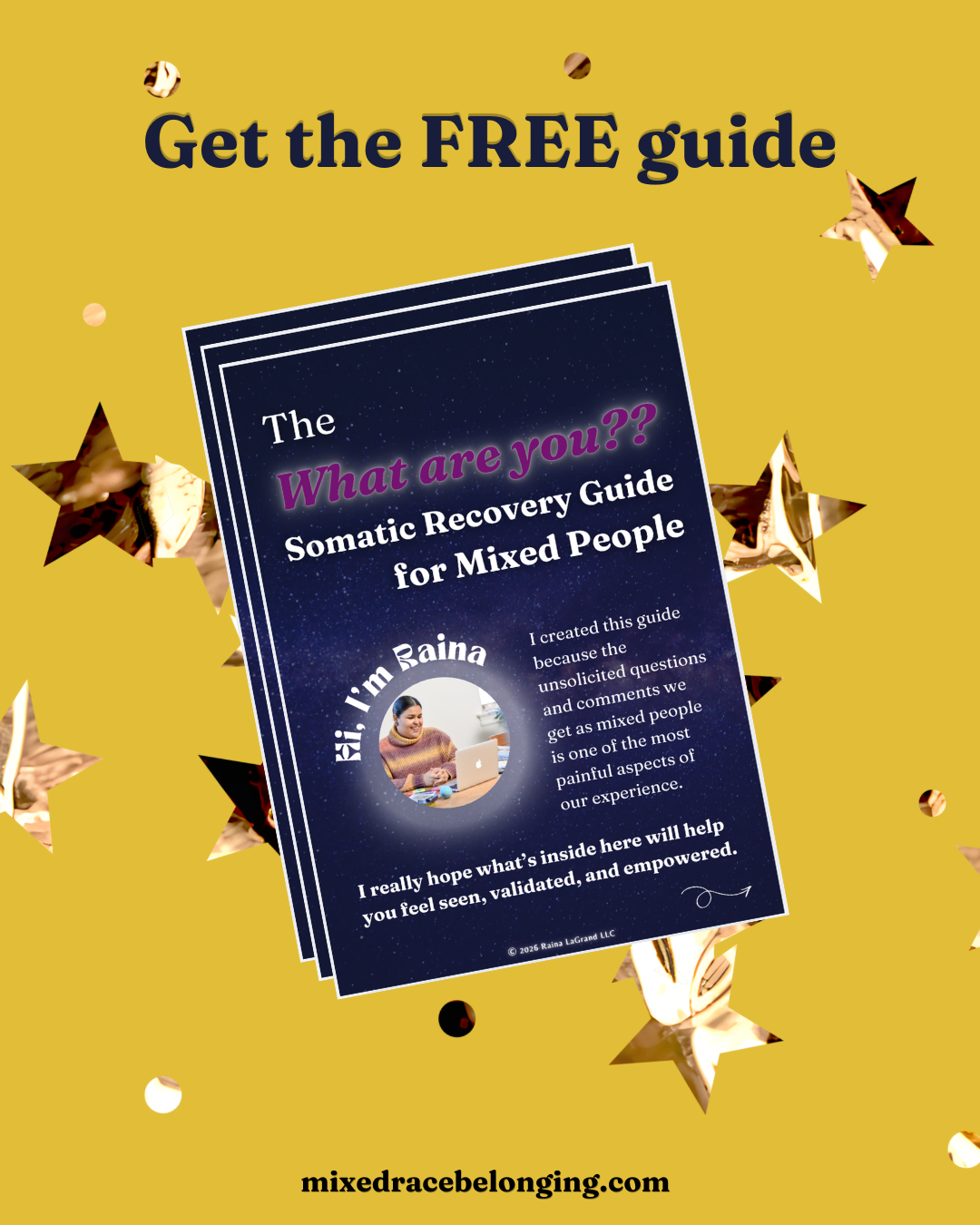
That’s why I'm so excited to share a free resource with you. It's my“What Are You?” Somatic Recovery Guide.
This guide is designed to help mixed race people respond to and recover from being misread and microaggressed without forgetting who the FUCK you are.
When you download the guide, you're going to learn:
10 different responses you can put in your back pocket for those times when people ask, “what are you?”
A somatic practice that's going to help to soothe your mind, body, and soul and find your center again in that moment (in text and video form)
And how to build emotional resilience so that you can keep feeling whole, even when people are misreading or questioning your racial identity in the future.
These tools helped one of my clients who used to completely spiral and feel frozen and clammy anytime somebody would ask her if she was mixed. But after implementing these tools, she feels open, she feels curious, she feels proud. She doesn't feel like she has to prove her blackness or atone for having three white grandparents.
What you'll learn in this guide is going to help you with other aspects of your life, other aspects of your identity that feel hard, like being a baby queer or being neurodivergent or having chronic illness.
So if you want to stop spiraling every time someone asks about your racial identity OR other identities…if you're ready to just feel like confident and unbothered by people's questions, you can get your FREE copy of this guide delivered straight to your inbox.
Resources Cited
Hom, Sabrina L. (2025). Critical Mixed Race Philosophy.
Nadal, Kevin et. al. (2011). Microaggressions and the Multiracial Experience. International Journal of Humanities and Social Sciences. 1.
Nadal, Kevin et. al. (2013). Microaggressions Within Families: Experiences of Multiracial People. Family Relations. 62. 190-201.
