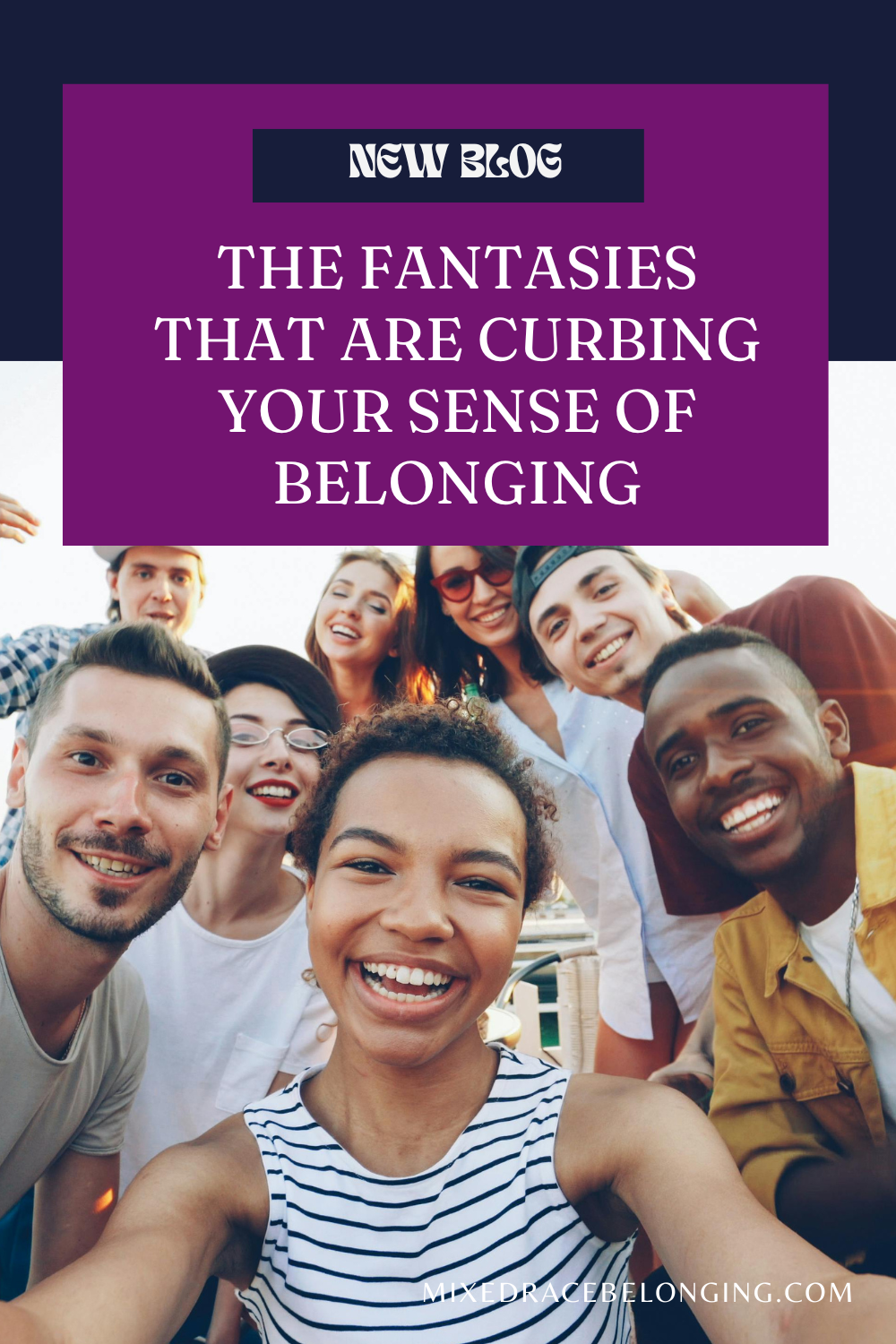
The Fantasies That Are Curbing Your Sense of Belonging
As a coach for mixed race people for the last five years – and trauma therapist for nearly a decade – I’ve noticed that people of all identities tend to fixate on at least four fantasies about friendship and belonging. And when those fantasies aren’t met, it can leave you feeling like a complete failure.
In this blog, I’m going to talk about what those fantasies are, what the research actually says about friendships, and how you can find friendship fulfillment.
Friendship Fantasies
There are at least four types of fantasies many people tend to have about friendship and community:
The fantasy of having one singular BFF
The fantasy of having a singular group of friends where all your needs are met
The fantasy that your family will provide all the friendship you need (aka “family over everything”)
The fantasy that a romantic partner will be your best friend and all you need
And an additional fifth that is more common for mixed people and people of color specifically, which is the fantasy of belonging with people who specifically share your racial identity.
Don’t get me wrong – there are billions of people in the world which means the chances that some people are living out these fantasies is real. But it’s important to remember that just because none of these fantasies mirror your reality doesn’t mean that you can’t feel fulfilled in your social life.
Research about Friendships
Research shows that having more friends (generally) is associated with better health outcomes, but there is some nuance here. Let’s get into it.
How many friends do you need?
There’s a certain threshold of relationships that tends to reduce loneliness, anxiety, and depression, and that number runs somewhere between 3-5 people.
These 3-5 people represent your sort of “inner circle.” Within that inner circle, you may have 1-2 people who you are more intimately connected to, and 2-3 people who you are generally emotionally connected to.
Outside of that, research generally points to having about 10-15 people you see regularly, and having 30-150 (I know that’s a big number!) acquaintances. Ideally, these social networks are also interconnected, rather than isolated one-on-one friendships – but interconnected doesn’t necessarily translate to “one friend group.”
Quality over Quantity
Importantly, excessively large friendship groups (like having about 15 close friends) seems to negatively affect mental health.
The reason large friend groups don’t work out seems to be because managing more friends means the quality of those relationships go down. These friends may not be as reliably available for support, you might not share the same core values, and it can be harder to repair from conflict because there isn't as much trust that has been developed.
The Importance of Being Your Own Person as a Mixed Person
Unbelonging
As a biracial or multiracial person (or bi/multi ethnic/cultural), you might feel like you’re starting in a deficit because you don’t have the same “built-in” belonging that others do in your family, and it’s also been hard to find belonging in broader community settings. But it can also be really helpful to have clarity about what relationships aren’t offering the quality of connection you deserve.
The research on the quality of relationships needed to positively influence wellbeing, to me, feels like an invitation to shift your focus away from the people and places where you feel chronically misunderstood and invalidated.
This includes people and places you might feel like you “should” belong – such as those who share aspects of your racial identity who are not able to respect the complexity of your own racial identity.
One of the most COMMON questions I get is “how do I approach my friend/cousin/mom about [insert problematic thing they do]?”
And while there is a time and place where strategizing a conversation with family members – or certain friends – it can also be helpful to zoom out and shift your focus.
Author, and friend, Gayatri Sethi, says in her revolutionary book Diaspora-ish: notes on Identities, Unbelonging, & Solidarities:
“Identities matter, but not always in the ways we are taught they do.
Belonging is a core human need, but so much harm transpires under the guise of belonging.
We are taught to lean into identity or find safety in belonging instead of reaching for something else entirely.
We mistake representation into the norm as a sign of progress instead of questioning these norms.
We might need to trade in quests for identities & belonging for new inquires:
What do we do with our identities and belongings?
How do we make braver & safer spaces for each other?Identities & belongings matter little unless we are leveraging these identities & belongings to welcome & value each other”
Gayatri’s words are a reminder that belonging is not, and never have been about, just sharing identity with someone. That kind of belonging doesn’t matter if it comes at the expense of anyone’s dignity – yours or someone else’s. This also feels reminiscent of civil rights activist Fannie Lou Hammer's famous words "no one is free until everyone is free.”
The Psychology of Differentiation
The ability to reject where and with whom we do not share relationship values with is supported by research on emotional wellbeing, which shows that the ability to differentiate your own identity, values, and emotions from that of others (family, your partner, etc.) generally results in less stress, greater resilience, and better relationship health. Part of that being because you are less likely to fall into survival strategies like defaulting to defensiveness, people-pleasing, or impulsively cutting people off.
When you can differentiate yourself from others, and understand that your individuality is as important as your ability to be in relationship with others, this makes it possible for you to think beyond ‘what do I need to do to earn belonging?’ and also ask yourself, ‘what kind of belonging do I need? ’
What Needs Do Friendships Meet?
All of this is why I believe establishing a reliable support circle of at least three chosen family members is so important for mixed race people – and why it’s important to think expansively about who those chosen family members will be.
It can be deeply healing to find belonging in a certain cultural group – and we can hold this possibility. But it is also possible to have your needs met by other kinds of people, even if you continue to leave the door open for racial identity-based belonging.
As a young adult, I did not have many mixed race friends. Those came later in life. But I did find belonging with other people who shared my interests, values, and could relate to my life experiences.
I developed friendships with other activists, I had one friendship based entirely on trying new restaurants, and I found solace in relationships with third culture kids — individuals raised outside of their ancestral homelands, people whose parents had immigrated to the United States, or those who had been born in other countries and moved here when they were young. I found that these individuals understood what it was like to live between cultures, and that it wasn’t “just” because I was mixed that I felt such homelessness, culturally.
How to Build Fulfilling Relationships as a Mixed Race Person
Inside my one-on-one coaching offer, Bold Belonging, I help mixed people who feel a lack of belonging in their own families build a chosen family network of at least three people. This program is designed to support you even if you worry that you’re “not enough” or that you’re “too much.”
If you have grown accustomed to adjusting yourself to fit everyone else’s expectations, then you likely don’t actually have relationships where you feel seen, because those relationships are built based on what you’ve been performing.
Working together, I’ll teach you five core belonging skills that will help you build loving, authentic relationships where you’ll finally feel seen, held, and supported no matter what you’re going through – without shrinking, shapeshifting or pushing to be seen.
Because you deserve a belonging that makes you feel whole.
I offer free 60-minute consultation calls for Bold Belonging. On that call, we’ll do a short audit of your current community, identify who you can deepen your relationship with, what needs are going unmet in your current circle, and talk about how Bold Belonging can help you build relationships where you can actually show up as your full self and feel totally and completely fulfilled.
Imagine having a friend who knows just what you need after a long day.
Imagine having a soft place to land after a hard family gathering.
All this – and more – is possible when we work together.
Resources Used
Degges‐White, S., & Kepic, M. (2020). Friendships, subjective age, and life satisfaction of women in midlife. Adultspan Journal, 19(1), 39-53.
How many friends do you really need in adulthood?. Psychology Today. https://www.psychologytoday.com/us/blog/lifetime-connections/201908/how-many-friends-do-you-really-need-in-adulthood
Evidence brief: How many friends do you need?: Social connection guidelines. Evidence Brief | How Many Friends Do You Need? | Social Connection Guidelines. (n.d.). https://www.socialconnectionguidelines.org/en/evidence-briefs/how-many-friends-do-you-need
Russell, T. (2025, May 10). What is differentiation? meaning in therapy & relationships. Cascade Counseling Utah | Reconnect With What Matters. https://www.cascadecounselingutah.com/blog/understanding-differentiation-in-therapy-why-it-matters-for-your-mental-health/
